

komadmkomadmnextEdit Profile
Salt is used in the cuisines around the world for creating good taste and it is necessary for good health.
Salt is a common white mineral made primarily of sodium chloride (chemical formula is NaCl), used mainly to season and preserve food. In chemistry, salt is any compound formed when an acid and a base react together. The fine white salt crystals harvested mostly from evaporated seawater or underground rock mines.
For healthy adults, the World Health Organization recommends consuming less than 5 grams of salt per day (about one teaspoon, or 2,000 mg of sodium). People with some medical conditions which is worsen by excess salt intake are often advised by their doctors to follow a much stricter low-sodium diet (typically 1,500 mg of sodium or less per day).
What is the Purpose of Using Salt in the Cooking?
In cooking, the primary purpose of salt is to enhance flavor, balance taste, and alter the texture and preservation of food. Rather than simply making food taste “salty,” salt acts as a chemical tool that unlocks the natural flavors already present in ingredients.
In small amounts, salt stimulates your taste buds and releases aromatic compounds, making meat taste meatier, vegetables taste fresher, and baked goods taste richer. Salt chemically blocks bitter taste receptors on the tongue. Adding a pinch of salt to dark chocolate, coffee, or bitter greens (like kale) makes them taste smoother and sweeter. In desserts like caramel or cookies, salt cuts through heavy sugar to prevent the dish from tasting one-dimensional.
When salt is applied to meat before cooking, it dissolves muscle proteins, allowing the meat to hold onto more moisture so it stays juicy when cooked. In bread baking, salt tightens gluten strands, giving the dough better elasticity and structure while controlling how fast the yeast ferments. Sprinkling salt on vegetables like eggplant, cucumber, or cabbage pulls out excess water (osmosis), preventing dishes from becoming soggy and intensifying the vegetable’s flavor.
Salt draws water out of food and microbial cells, creating an environment where spoilage bacteria cannot survive. This is the basis for curing meats (like bacon), pickling vegetables, and making cheese.
What Kind of Salts are There?
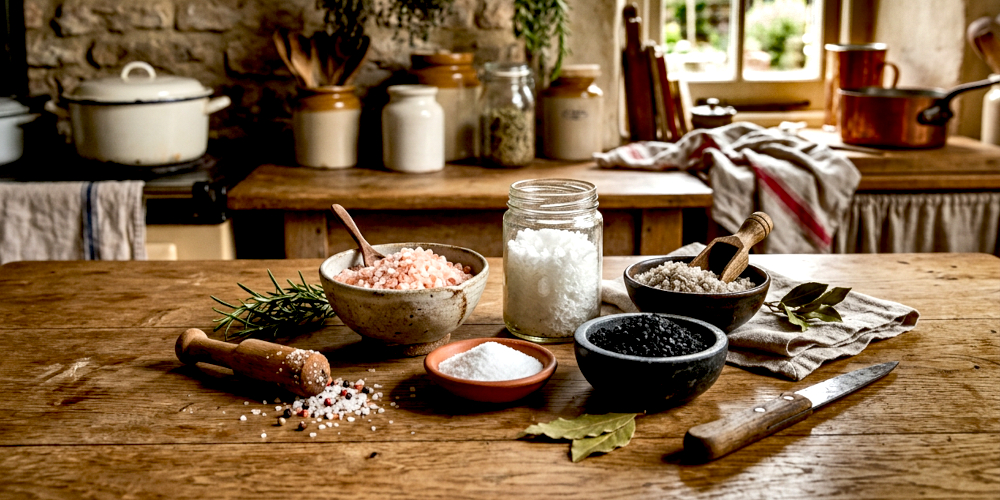
Cooking salts are primarily categorized by their source, grain size, and texture, which determine how they dissolve and flavor food.
Table Salt – Fine-grained, heavily refined salt mined from underground deposits. It usually contains anti-caking agents to prevent clumping and is often fortified with iodine (iodized salt). Best for baking and everyday shaking at the table.
Kosher Salt – Coarse, flaky crystals with no additives or iodine. Its large grain size makes it easy to pinch with your fingers, making it the top choice for chefs when seasoning meat and vegetables during cooking.
Sea Salt – Harvested directly from evaporated seawater. It comes in both fine and coarse grains and retains trace minerals that give it a slightly more complex flavor than table salt.
Flaky Sea Salt – Delicate, pyramid-shaped crystals (such as Maldon salt) that dissolve quickly and add a satisfying crunch. It is sprinkled on top of dishes—like steaks, salads, or chocolate chip cookies—right before serving.
Fleur de sel – A rare, delicate sea salt hand-harvested from the top layer of salt ponds in France. Known as the “caviar of salts,” it is moist, flaky, and strictly used as a finishing touch.
Himalayan Pink Salt – Rock salt mined in Pakistan that gets its pink color from trace minerals like iron. It is sold in fine grains for cooking, coarse grains for grinders, or even as solid blocks for grilling and serving.
Celtic Sea Salt (Sel Gris) – A moist, gray-tinted sea salt harvested in France using clay-lined ponds, which give it a high mineral content and briny flavor.
Smoked Salt – Sea salt that has been cold-smoked over wood fires (like hickory, applewood, or oak) to add a smoky barbecue flavor to dishes without grilling.
Pickling / Canning Salt – Ultra-fine, pure sodium chloride with zero additives or iodine. Because it contains no anti-caking agents, it dissolves completely without turning pickling brine cloudy.
Curing Salt (Prague Powder) – A mix of table salt and sodium nitrite (often dyed bright pink to prevent confusion with regular salt). It is used strictly for preserving meats like bacon, ham, and sausages.
What is the Significance of Iodine in Table Salt?
In many inland and mountainous regions of the world, the soil lacks natural iodine, meaning locally grown fruits and vegetables do not contain enough of it. Because the human body cannot make iodine on its own, fortifying everyday table salt provides a cheap, reliable way for people to get this essential trace mineral. Adding tiny amounts of potassium iodide or potassium iodate does not change the taste, smell, or appearance of the salt.
Lacking natural iodine in your diet leads to an underactive thyroid (hypothyroidism), causing fatigue, weight gain, and dry skin. Your thyroid gland uses iodine to make thyroid hormones (T3 and T4). These hormones control your body’s metabolism, heart rate, body temperature, and energy levels. Without enough iodine, the thyroid gland enlarges, a condition called a goiter, as it tries to trap more iodine from the blood. Small, painless goitres with normal thyroid hormone levels and no symptoms often only need regular checkups and monitoring. Removing part or all of the thyroid may be recommended if a goitre causes trouble breathing or swallowing, grows large, or involves suspicious or cancerous nodules.
Iodine is also critical for brain and skeletal development during pregnancy and early childhood. According to the World Health Organization, iodine deficiency is the world’s leading preventable cause of intellectual and developmental disabilities.
Excess Salt Consuming and the Human Health
Your body needs a small amount of sodium to survive, yet eating too much is a leading cause of high blood pressure and heart disease. Sodium in the salt causes the body to retain water and increases blood volume, and this can rapidly worsen symptoms or trigger salt related complications in some medical conditions. Consuming too much salt is particularly dangerous in medical conditions that affect blood pressure, fluid balance, and organ filtration, such as hypertension, heart failure, chronic kidney disease, bone weakness, and liver cirrhosis.